Premier Pilot Plant People

 Call Us
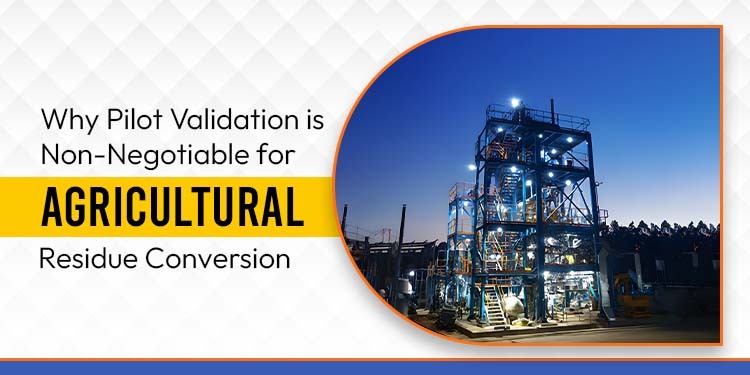
Why Pilot Validation is Non-Negotiable for Agricultural Residue Conversion
A Traditional Outlook on Modern Processes
The drive for sustainability and new material streams has brought agricultural residue conversion to the forefront of the chemical and energy industries. This is certainly an innovative field, but its execution must be grounded in traditional engineering disciplines. History shows us that processes dealing with complex, non-homogeneous feed materials like agricultural residues are inherently challenging to scale. The data is clear: large-scale biomass processes inevitably break when teams skip the crucial stage of scale realism. This realism cannot be attained in a static laboratory environment. A full-scale operation is a dynamic, complex, and continuous system. It is our firm conviction that only a properly executed pilot plant operation can eliminate the risk associated with this transition by simulating true, 24/7 industrial operating conditions. This is the practical minimum standard for success.The Critical Areas Where Scale Realism Matters
The decision to start agricultural residue conversion at the pilot scale is centered on mitigating four primary technical and operational risks that are invisible at the bench level. A pilot facility, such as those provided by Xytel, is not merely a larger lab; it is an integrated, functional model of the future commercial facility.1. Stress-Testing Real Feedstock Variability
Agricultural residues are highly variable; they change with the season, the region, the harvest method, and even the weather. This inherent feedstock variability is the silent killer of many biomass projects. A pilot facility must test the extremes of the feedstock range, wettest, driest, highest ash, and lowest protein to establish a practical operating envelope. Without this data, the commercial facility’s upstream material handling, pretreatment, and reactor sections will be improperly designed, leading to continuous downtime and failed yields. This practical data is essential for operational stability.2. Validating High-Solids Slurry Handling
Many agricultural residue conversion processes rely on mixing high concentrations of solids with liquids to maximize production throughput. At a commercial scale, handling high-solids slurries introduces complex rheological challenges, pumping issues, and fouling problems that simply do not manifest in small batches. High-solids slurry handling is often the first point of failure in scaling up. Pilot plants provide the volume and geometry necessary to observe these fluid dynamics under realistic pressures and continuous flow rates, allowing engineers to validate equipment choices before millions are spent on commercial-sized components.3. Proving Continuous Reactor Stability
A successful project is a continuous project. While a lab reactor can achieve a high conversion rate over a few hours, the true measure of success is the ability to maintain that performance for months on end. Achieving continuous reactor stability requires validation in a system designed for ongoing operation. This includes verifying catalyst life, managing heat transfer and pressure drops over long periods, and proving out start-up and shut-down sequences. The complexity of these long-term dynamics simply demands the operational realism of the pilot scale.4. Generating Investor-Grade Performance and Reliability Data
Above all, projects must be financially viable. Turning agricultural residues into value starts with one step: pilot validation. The technical outcomes of a pilot plant directly translate into the financial projections of the commercial venture. The pilot operations must generate investor-grade performance and reliability data. This data is the empirical proof required to secure significant financing, satisfying the financial institution’s or investor’s mandate for de-risking the technology. Without this proven, reliable operational history, the funding pitch remains purely theoretical.The Mandate for Industrial Certainty
For companies like Xytel, we understand that our function is to deliver industrial certainty for the biomass pathway. Our pilot plants are built from the ground up to provide that surety. They incorporate the sophisticated industrial mechanisms necessary to replicate commercial reality:- Continuous reactors
- High-pressure filtration systems
- Automated material handling
- Full PLC–SCADA automation
Get in Touch
You will be amazed as how partnering with us becomes a game changer in your quest for R&D glory.