Premier Pilot Plant People

 Call Us
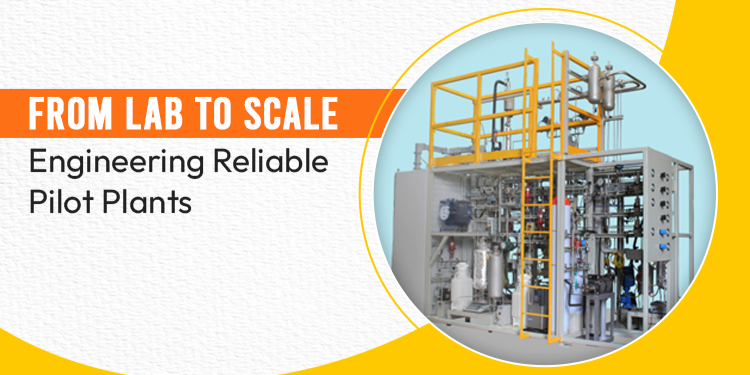
From Lab to Scale: Engineering Reliable Pilot Plants
This blog explores how engineering precision, particularly regarding thermal stability and process control, transforms a theoretical success into a functional, scalable reality through the development of reliable Pilot Plants. In the process industries, the leap from R&D to commercial production is fraught with technical risks that extend far beyond simple chemistry. Success depends on the ability to replicate laboratory results at scale, a feat that requires meticulous engineering and controlled environments. By focusing on thermal stability and accurate data generation, companies can mitigate risks and ensure that their industrial-scale operations remain efficient and predictable.Building Reliable Pilot Plants
The journey from a successful laboratory experiment to a high-output industrial plant is rarely a straight line. For engineers and project managers in the chemical, pharmaceutical, and oil and gas sectors, this middle ground is where the most significant challenges emerge. While a reaction might work perfectly in a glass beaker, scaling that same reaction to thousands of liters introduces variables that can jeopardize the entire project. This is why the creation of reliable Pilot Plants is not just a luxury; it is a technical necessity for modern industry.The Hidden Risks of Scale-Up
Many organizations mistakenly believe that scaling up is merely a matter of building larger versions of laboratory equipment. However, the primary cause of failure in the transition to production is rarely the chemistry itself. Instead, it is often the inconsistency of process conditions. In a small-scale lab setting, maintaining a uniform temperature or pressure is relatively simple. As the volume increases, these factors become much harder to manage. Thermal instability is a frequent culprit. If a Pilot Plant cannot maintain precise thermal control, the resulting data becomes skewed. This leads to scale-up surprises where the commercial facility fails to meet purity standards or experiences unexpected safety issues. To prevent this, the engineering phase must prioritize a controlled environment that mirrors real-world industrial conditions while providing the flexibility of a research setting.The Role of Precision Engineering in Process Validation
The fundamental purpose of reliable Pilot Plants is to provide a platform for process validation. Before committing millions in capital expenditure to a full-scale facility, stakeholders must have total confidence in their data. This confidence is built on three specific pillars:- Accuracy in Data Acquisition: Every sensor and control loop in the Pilot facility must be calibrated to provide high-fidelity data. Without this, you are essentially flying blind.
- Repeatability: A process that works once is a fluke; a process that works one hundred times under the same conditions is a viable business. Reliable Pilot Plants are designed to deliver these repeatable results consistently.
- Stress Testing: The Pilot phase is the time to find the limits of the process. Engineering solutions must allow for the testing of various “what-if” scenarios, from pressure spikes to raw material variations, without risking a total system failure.
Bridging the Gap from R&D to Production
At Xytel, the focus is on creating engineered solutions that serve as a robust bridge between initial research and final production. This involves more than just assembling hardware; it requires an integrated approach that spans from the initial concept to the final commissioning of the plant. By integrating advanced automation and controlled thermal systems, it is possible to ensure that the performance seen in the Pilot phase is exactly what will be experienced on the factory floor. This level of integration helps in making data-driven decisions that lower the overall risk profile of the project.Industry-Specific Requirements
The needs of a Pilot Plant vary significantly depending on the sector. For instance:- Oil & Gas: Requires systems capable of handling high temperatures and pressures while managing complex hydrocarbon chains.
- Chemical Manufacturing: Often focuses on catalyst testing and specialized mixing processes where precision is paramount.
- Pharmaceuticals: Demands extreme cleanliness and precise control over reaction kinetics to ensure patient safety and regulatory compliance.
Why Controlled Environments Matter
Inconsistent process conditions are the enemy of innovation. When a Pilot Plant operates in an environment that is not properly controlled, it introduces noise into the data. This noise can mask inefficiencies or, worse, hide potential safety hazards. Reliable Pilot Plants utilize sophisticated engineering to isolate the process from external variables. This ensures that the results gathered are a direct reflection of the process chemistry and mechanics. When these systems are designed with an eye toward future scale-up, the transition to industrial-scale operations becomes much smoother and more predictable.Making Data-Driven Decisions
In the modern industrial landscape, guessing is not an option. Every decision, from the choice of materials to the layout of the piping, must be backed by evidence. A well-engineered Pilot Plant acts as a data factory, churning out the metrics needed to optimize the final production line. By investing in high-quality engineering solutions early in the development cycle, companies can avoid the fail-fast traps that plague many R&D projects. Instead, they can move forward with the certainty that their process is not only scientifically sound but also commercially viable. Success in the process industries does not begin on the day a commercial plant goes online. It begins months or years earlier, in the controlled environment of a Pilot facility. By focusing on precision, reliability, and thermal stability, organizations can ensure that their innovations successfully make the leap from the lab to the global market. Building reliable Pilot Plants is about more than just equipment; it is about building confidence. When you have the right engineering partner and a clear focus on process integrity, the journey to full-scale production becomes a calculated progression rather than a high-stakes gamble. Don’t let engineering gaps stall your transition from R&D to full-scale production. Partner with Xytel to design a Pilot Plant built for reliability and precision.Get in Touch
You will be amazed as how partnering with us becomes a game changer in your quest for R&D glory.