Premier Pilot Plant People

 Call Us
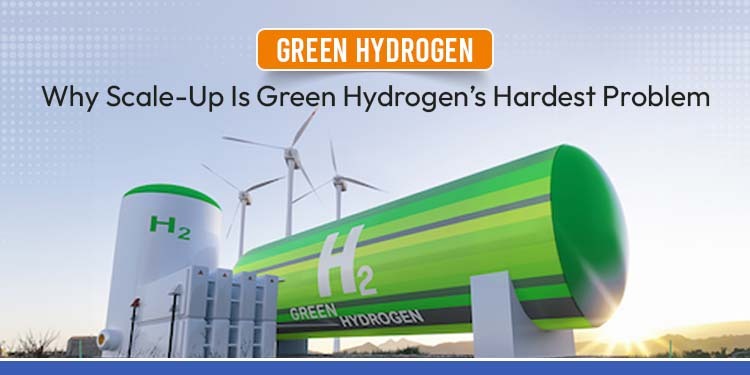
Green Hydrogen: Why Scale-Up is Green Hydrogen’s Hardest Problem
The Real Challenge of Green Hydrogen
Green hydrogen has emerged as a crucial component in global industrial decarbonization efforts. While the fundamental science of electrolysis using renewable power is proven, less than 1% of global energy consumption currently comes from this source. The significant gap between ambition and reality is not a failure of technology but a systemic challenge of operability. Moving green hydrogen production from the laboratory to large, continuous industrial deployment introduces complex, interacting variables from compression and storage to dynamic control under fluctuating renewable loads. The hardest problem in hydrogen scale-up is generating the necessary operating evidence. True progress depends on validating integrated hydrogen systems through long-run, real-world pilot plants before committing to full-scale infrastructure. The world has firmly placed its bets on green hydrogen as a cornerstone of future energy systems, essential for decarbonizing heavy industries like steel, refining, fertilizers, chemicals, and mobility. The optimism is well-founded: the core underlying science is solid, electrolyzers function effectively, and the availability of renewable power continues its strong upward trajectory. And yet, despite this considerable momentum, green hydrogen still accounts for a fraction well under 1% of global final energy consumption. The persistence of this chasm between the projected future and the current state is a key indicator of a deeper, more systemic issue that goes beyond mere ambition or technological novelty. The gap exists because hydrogen production becomes fundamentally more complex, and therefore riskier, once it transitions from a controlled laboratory setting to real, demanding industrial operating environments.The Operational Reality: From Chemistry to Complex Engineering
The common mistake in evaluating hydrogen scale-up potential is treating electrolysis as an isolated process. In practice, running a successful, profitable green hydrogen plant is not just about making hydrogen; it is about managing an integrated system. Electrolysis is merely the initial chemical reaction. What follows are the critical subsystems of compression, gas separation, bulk storage, and downstream utilization, which introduce interconnected layers of operational interaction. These are the elements that ultimately determine whether a hydrogen system is bankable or a source of continuous friction. These subsystems must operate harmoniously, day in and day out, often under dynamically fluctuating loads from renewable sources, variable pressures, and stringent regulatory safety requirements. The challenges are practical and rooted in physics:- Pressure Transients: Sudden or unexpected pressure spikes and drops within the system, especially in high-pressure lines, can introduce stress on equipment, compromise seal integrity, and trigger unplanned shutdowns.
- Part-Load Inefficiencies: While electrolyzers perform well at peak power, efficiency often drops more sharply than anticipated when operating under the variable inputs inherent to renewable energy sources such as solar and wind.
- Compression Energy Penalties: The energy required to compress hydrogen for storage or transport can become a significant operating expenditure, often underestimated in initial financial projections.
- Tightly Interlocked Safety Logic: Modern hydrogen systems rely on intricate safety protocols. A seemingly minor issue in one subsystem can propagate a fault that leads to a full system shutdown, halting production and incurring major costs.
Where Early Deployments Encounter Friction
Through early global deployments and demonstration projects, common operational patterns have begun to emerge, patterns that highlight the distinction between component testing and systemic validation:- Load Stability: Control strategies that perform adequately in short, high-level trials often struggle to maintain stable operation across days or weeks of continuous, dynamic input.
- Pressure Management: Maintaining stable operation is observably harder at higher output pressures, complicating the goal of reducing the physical footprint of storage.
- Unanticipated Safety Shutdowns: Safety systems, while essential, initiate unexpected shutdowns due to control logic nuances that were not fully captured during the initial design phase.
Pilot Plants: The Strategic Imperative for Bankable Hydrogen
The industry must adopt a traditional, risk-averse outlook when confronting a complex new energy vector like green hydrogen. Pilot plants are no longer a simple transitional step between research and development (R&D) and scale; they have evolved into essential, strategic infrastructure. A modern, well-designed hydrogen pilot plant acts as the crucial de-risking step, providing the operating evidence that truly matters:- Validation of Load stability under dynamic and variable renewable input conditions.
- Proof of consistent pressure and temperature control across extended runtime.
- Demonstration of reliable, repeatable start-up and shutdown logic for daily cycles.
- Measurement of Energy efficiency across the full operational envelope, especially at part-load.
- Long-term confirmation of safety system behavior under both normal and off-nominal scenarios.
The Role of Xytel in Operationalizing Green Hydrogen Confidence
At Xytel, we understand that confidence must be engineered before it can be financed. Our specialization is bridging the gap between ambitious green hydrogen technology and industrial-grade deployment. We design and construct modular, pilot-scale infrastructure with a singular focus: turning ambition into certified operating proof. Xytel supports developers, technology providers, and research programs by delivering systems engineered specifically for continuous operation, enabling the validation of true real-world behavior. Our core capabilities in supporting hydrogen scale-up include:- Building high-pressure reactors and complex process systems.
- Integrating sophisticated gas–liquid separation units.
- Implementing precision instrumentation for detailed data logging of pressure, flow, and temperature.
- Providing fully automated PLC–SCADA control environments to manage dynamic input.
- Conducting data-driven validation of long-term operability, safety, and energy efficiency.
Get in Touch
You will be amazed as how partnering with us becomes a game changer in your quest for R&D glory.