Premier Pilot Plant People

 Call Us
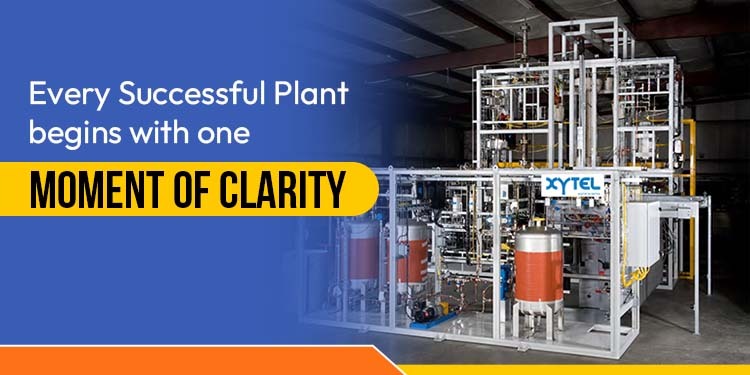
Every Successful Plant Begins with One Moment of Clarity
The transition from laboratory innovation to industrial reality is often fraught with technical ambiguity and financial risk. This blog explores how a structured approach to the Front-End Engineering Design (FEED) stage, powered by precise data conversion and Pilot Plant validation, provides the clarity needed to scale processes without costly surprises. In the world of process engineering, the path from a successful bench-scale experiment to a fully operational production facility is rarely a straight line. Many engineering teams enter the FEED stage with high ambitions and strong intent, yet they often find themselves hampered by scattered lab data and evolving assumptions. The pressure to get it right the first time is immense, particularly when capital-intensive decisions are on the line. At Xytel India, we have seen that the difference between a project that stalls and one that succeeds lies in a single moment of clarity. This clarity is not a stroke of luck; it is the result of converting limited bench data into a structured engineering framework that removes guesswork and replaces it with predictable outcomes.Bridging the Gap Between the Lab and the FEED Stage
The laboratory is a place of controlled precision, where chemical pathways are perfected in small volumes. However, as many process engineers know, what works in a 100ml flask rarely behaves the same way in a 5,000-liter reactor. This “Valley of Death” in process scale-up is where most technical risks reside. When teams move toward the FEED stage, they often carry over assumptions about heat transfer, mass balance, and fluid dynamics that haven’t been stress-tested. If these assumptions are baked into the final Plant design without validation, the result is often off-spec batches and mechanical bottlenecks. By prioritizing Pilot Plant engineering early in the project lifecycle, organizations can:- Identify scale-sensitive parameters such as pressure drops and thermal gradients.
- Verify the reproducibility of chemical reactions under continuous flow conditions.
- Validate catalyst life and selectivity in an environment that reflects industrial reality.
Converting Scattered Data into Structured Engineering
A common challenge in early-stage engineering is the lack of a cohesive data set. Research teams might have excellent results, but those results are often not in a format that a design engineer can use to size a heat exchanger or specify a pump. Xytel India specializes in pre-engineering studies that bridge this gap. We take your laboratory innovations and translate them into comprehensive FEED packages. This involves:- Conceptual Design Confirmation: Reviewing the initial research to ensure it aligns with operational requirements.
- Technical Issue Clarification: Systematically resolving challenges related to material handling or complex rheology before they become procurement problems.
- Integrated Engineering Excellence: Developing precise process flow diagrams (PFDs) and P&IDs that serve as a blueprint for the entire project.
The Power of the FEED Package in Decision Making
Investment decisions in the chemical, pharmaceutical, and energy sectors require transparency. Stakeholders need more than just a proof of concept; they need defensible data regarding costs, performance, and safety. A robust FEED package acts as a strategic asset. It allows for:- Transparent Investment Decisions: By providing accurate estimates for capital expenditure (CAPEX) and operational expenses (OPEX), we enable leadership to move forward with financial certainty.
- Removing Guesswork: Instead of relying on spreadsheet assumptions, the design is based on the physical behavior of materials in a Pilot-scale environment.
- HAZOP and Safety Integration: Identifying potential operational risks early ensures that safety is a built-in feature of the Plant, not an afterthought.
Asking the Right Questions Early
The most expensive mistakes in Plant construction are the ones that could have been avoided by asking the right questions during the initial design phase. If your process is entering the FEED stage, consider these critical points:- Are the utility loads sized for real-world operations or just theoretical peaks?
- How will feedstock variability affect the upstream material handling?
- Is the control philosophy robust enough to handle start-up and shut-down sequences?
Why a Modular Approach Matters
Modern process development favors flexibility. Xytel India’s expertise in skid-mounted and modular Pilot Plants provides a faster route to market. These systems are engineered to be easily integrated into existing facilities, allowing for rapid testing and adjustment. This modularity, combined with advanced automation and control systems, ensures that the data gathered is accurate, repeatable, and ready for commercial-scale application. Innovation does not have to be a gamble. Every successful Plant begins with the clarity to see the process for what it is, a series of engineering challenges that require data-driven solutions. By choosing to invest in structured engineering and Pilot-scale validation, you are not just building a Plant; you are securing the future of your technology. With over three decades of experience and more than 225 successful projects globally, Xytel India continues to lead the way in transforming ideas into industrial reality. We help you move from the lab bench to the production line with the technical confidence that only professional Pilot Plant engineering can provide.Get in Touch
You will be amazed as how partnering with us becomes a game changer in your quest for R&D glory.