Premier Pilot Plant People

 Call Us
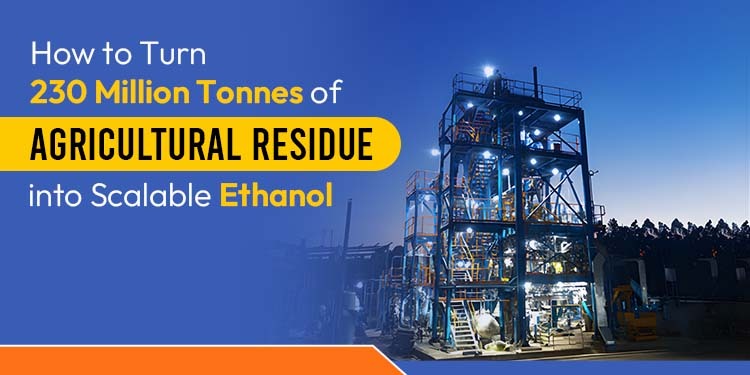
How to Turn 230 Million Tonnes of Agricultural Residue into Scalable Ethanol
India produces over 230 million tonnes of agricultural residue annually, yet the transition from this raw biomass to commercial-scale ethanol remains a significant engineering hurdle. The primary challenge is not a lack of vision but the inherent difficulty of scaling lignocellulosic processes. Lab-scale successes often falter when faced with the physical realities of feedstock variability and the limitations of batch processing. Xytel India addresses this critical missing link by providing continuous pilot plants. These systems allow producers to move beyond lab assumptions, using real-world data from pre-treatment, enzymatic hydrolysis, and fermentation to ensure commercial viability and operational stability. The ambition to transform India’s agricultural landscape into a powerhouse for renewable energy is supported by a massive availability of raw materials. With more than 230 million tonnes of agricultural residue generated every year, the potential for 2G ethanol production is vast. However, the industry has observed a recurring pattern that technologies that perform exceptionally well in a controlled laboratory setting often struggle to maintain their efficiency when scaled up to a commercial level. The failure of ethanol scale-up rarely happens on paper. It occurs in the transition between a benchtop experiment and an industrial facility. At Xytel India, we recognize that the path to a successful biofuel economy requires more than just good chemistry; it requires rigorous engineering that accounts for the unpredictable nature of lignocellulosic feedstocks.The Reality of Feedstock Variability
Lignocellulosic biomass, such as rice straw, wheat stalks, and corn stover, is not a uniform material. Its composition varies by region, season, and even harvest methods. In a lab, researchers often use homogenized samples that behave predictably. Batch reactors, while useful for initial testing, amplify these variabilities. They lack the precision required to maintain consistent results when processing tonnes of material. This is where many projects encounter delays or financial losses. Without a way to simulate industrial conditions during the development phase, the risks associated with 2G ethanol production remain prohibitively high.Bridging the Engineering Gap with Continuous Pilot Plants
Xytel India specializes in the design and construction of continuous pilot plants that serve as a bridge. Unlike batch systems, our continuous units provide a steady-state environment that mirrors the conditions of a full-scale refinery. These pilot plants focus on three critical stages of the conversion process:- Advanced Pre-treatment Systems: This is the most energy-intensive part of the process. Our systems are designed to break down the complex structure of biomass consistently, ensuring that the subsequent stages receive a uniform feed.
- Enzymatic Hydrolysis: Converting cellulose into fermentable sugars requires precise control over temperature and mixing. Our continuous systems allow for the monitoring of residence times, ensuring that enzymes work at peak efficiency without the dead zones often found in large batch tanks.
- Industrial-Grade Fermentation: Scaling up biological processes is notoriously difficult. By using pilot-scale continuous fermentation, we help companies understand how yeast and other microorganisms behave under sustained industrial loads.
Moving Beyond Lab Assumptions
The goal of a pilot plant is not just to prove that the chemistry works, but to prove that the process is repeatable and profitable. Many developers rely on lab data that breaks when it meets the mechanical load of a large facility. A continuous pilot plant identifies these breaking points early. By maintaining controlled residence times and simulating the actual flow of materials, Xytel systems provide the data necessary to design full-scale pilot plants with confidence. This reduces the capital risk for investors and ensures that the eventual commercial facility can handle the 230 million tonnes of residue available in the Indian market.Why Continuous Systems Outperform Batch Processing
In the context of 2G ethanol, continuous processing offers several distinct advantages over traditional batch methods:- Consistency: Continuous systems eliminate the start-stop nature of batch processing, leading to a more stable output and easier quality control.
- Efficiency: These systems generally require a smaller footprint and lower energy consumption per gallon of ethanol produced.
- Data Reliability: The data gathered from a continuous pilot plant is directly applicable to the design of an industrial refinery, whereas batch data often requires complex and risky extrapolations.
- Handling Variability: Continuous systems are better equipped to handle the physical inconsistencies of agricultural residue, allowing for real-time adjustments to the process.
The Path to India’s Ethanol Blending Goals
India has set ambitious targets for ethanol blending in petrol. Meeting these goals requires a rapid increase in 2G ethanol production capacity. However, speed should not come at the expense of engineering integrity. The industry must move away from the “trial and error” approach at the commercial level and instead invest in robust pilot testing. At Xytel India, our focus is on providing the infrastructure that makes this transition possible. Our pilot plants are engineered to be versatile, allowing for the testing of various feedstocks and process configurations. This flexibility is vital in a market as diverse as India, where the available biomass can change significantly from one state to another.Conclusion
The transition from agricultural waste to sustainable fuel is one of the most important engineering challenges of our time. While the raw material is abundant, the technology to process it must be matured through rigorous, scale-ready testing. By moving from lab-based assumptions to data-driven continuous pilot plants, the industry can finally overcome the hurdles that have historically slowed down 2G ethanol production. Xytel India remains committed to supporting this journey, providing the technical expertise and the modular systems needed to turn India’s agricultural residue into a reliable energy source. The future of ethanol is not just in the lab; it is in the successful, predictable, and continuous scale-up of proven technology.Get in Touch
You will be amazed as how partnering with us becomes a game changer in your quest for R&D glory.