Premier Pilot Plant People

 Call Us
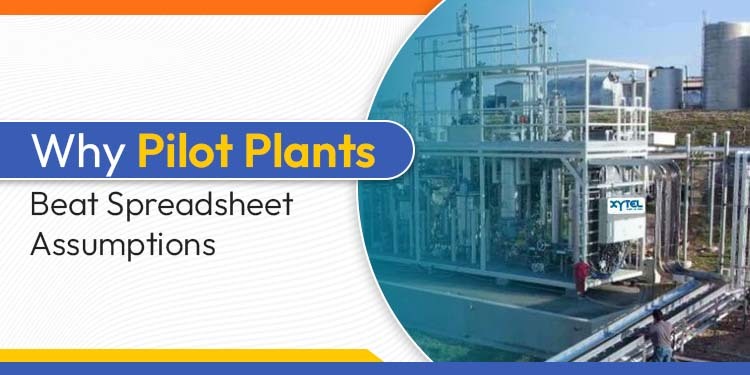
Why Pilot Plants Beat Spreadsheet Assumptions
While digital simulations and spreadsheets are vital for the initial stages of process design, they often fail to account for the complex, non-linear realities of physical operations. This blog explores why physical pilot plants are indispensable for identifying critical issues like fouling, maldistribution, and control instability before moving to full-scale production. By turning theoretical assumptions into empirical evidence, Pilot Plants provide the engineering clarity needed to mitigate risks and ensure long-term operational success. In the early stages of chemical engineering and process development, the spreadsheet is a sanctuary. It offers a controlled environment where every variable is known, every reaction is predictable, and every energy balance closes perfectly. Digital simulations allow engineers to test theories quickly and at a low cost. However, a significant gap exists between a mathematical model and a functioning industrial facility. While modern software is more sophisticated than ever, it operates on idealized conditions. It assumes perfect mixing, uniform heat distribution, and consistent feedstock. In the real world, physics is rarely that cooperative. This is where the pilot plant becomes the most valuable asset in a project’s lifecycle. At Xytel India, we have seen firsthand how moving from a laptop to a physical rig reveals the “scale-up surprises” that can break a project’s ROI if left unaddressed.The Limitations of Idealized Models
A spreadsheet is essentially a collection of assumptions. You assume a certain heat transfer coefficient, a specific catalyst activity, or a predictable flow rate. But a simulation cannot feel the grit of a raw feedstock or see the gradual buildup of deposits inside a heat exchanger. The primary reason a pilot plant beats a spreadsheet is that it introduces the element of time and physical entropy. Models are often steady-state, but industrial reality is dynamic. Without empirical data from a physical system, an engineering team is essentially betting millions of dollars on a digital “best-case scenario.”Identifying Fouling Behavior and Maintenance Realities
One of the most common oversights in digital modeling is fouling behavior. A simulation might tell you that a heat exchanger is 95% efficient based on its surface area and fluid properties. However, it cannot accurately predict how quickly carbon deposits, polymers, or inorganic scales will coat those surfaces. Fouling reduces efficiency, increases pressure drops, and eventually forces a shutdown. A pilot plant allows engineers to observe these deposits in real time. By monitoring performance over hundreds of hours, teams can develop realistic cleaning schedules and choose materials that resist buildup, preventing costly downtime at the commercial scale.Uncovering Maldistribution Hotspots
In a digital model, fluids usually flow exactly where you tell them to. In a large-scale reactor, gravity, viscosity changes, and internal geometry can lead to maldistribution. When certain areas of a catalyst bed receive more flow than others, it creates “hotspots.” These hotspots can lead to:- Accelerated catalyst deactivation.
- Reduced product selectivity.
- Potential safety hazards due to thermal runaway.
Managing Startup Transients and Control Instability
A process is rarely as vulnerable as it is during startup or shutdown. These “transient” states are incredibly difficult to model accurately because the system is in constant flux. A spreadsheet might show you the destination (steady-state), but it doesn’t show you the turbulent journey to get there. Control instability is another factor. How does the system respond when a pump surges or a valve sticks? Physical testing allows operators to tune control loops and observe the dynamic response of the equipment. This ensures that when the full-scale plant is commissioned, the operators are prepared for the swings and shifts that occur during daily operation.Accounting for Feed Composition Variability
In a laboratory or a simulation, we use reagent-grade chemicals, pure, predictable, and consistent. In a commercial environment, feedstock is often variable. Changes in moisture content, trace impurities, or seasonal temperature shifts can significantly alter reaction kinetics. A pilot plant acts as a stress test for these variables. By introducing actual industrial-grade feedstock into the process, engineers can see how the system handles “dirty” inputs. This helps in designing robust separation and purification stages that a theoretical model might have deemed unnecessary.Why Engineering Clarity Matters
The ultimate goal of any process development project is to minimize risk. Every assumption in a spreadsheet is a potential point of failure. By investing in a pilot plant, a company is essentially buying insurance against scale-up failure. At Xytel India, we focus on turning these uncertainties into engineering clarity. We understand that a pilot plant is not just a smaller version of a factory; it is a sophisticated diagnostic tool designed to break the assumptions of the design phase. When you see how your process actually behaves under stress, you can optimize the design with confidence. You can size your pumps correctly, select the right metallurgy, and guarantee your yields to stakeholders. In the world of complex chemical engineering, there is no substitute for the truth found in flowing pipes and reacting chemicals.Conclusion
The path to a successful industrial facility is paved with data, not just theories. While spreadsheets provide the map, a pilot plant provides the ground truth. By identifying fouling, maldistribution, and instability early, companies can ensure their scale-up is a success rather than a series of expensive corrections. If you are looking to eliminate scale-up surprises and move from assumptions to evidence, contact us at Xytel India. We provide the expertise and the infrastructure to help you see exactly how your process will perform in the real world.Get in Touch
You will be amazed as how partnering with us becomes a game changer in your quest for R&D glory.