Premier Pilot Plant People
 Call Us
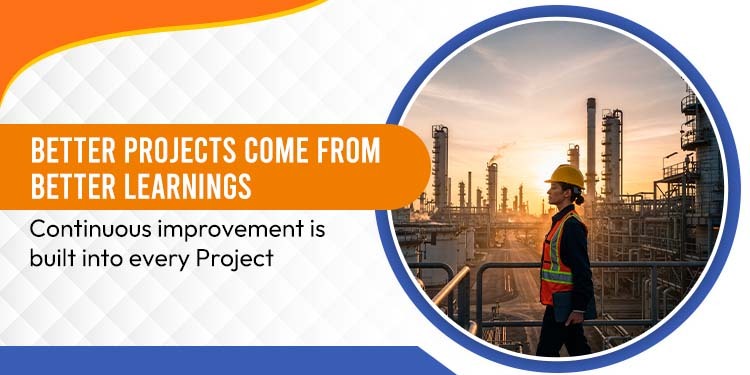
Better Projects come from better learning continuous improvement is built into every Project
Moving a chemical process from a controlled laboratory environment to an industrial production scale requires more than just multiplying equipment dimensions. This technical piece explores how embedding continuous improvement and systematic learning into Pilot Plant engineering mitigates design risks, stabilizes thermal dynamics, and ensures long-term operational reliability. By evaluating real-world execution frameworks, we explain how iterative project history, refined workflow structures, and advanced process simulation tools combine to yield highly predictable, skid-mounted automated systems. The transition from a bench-top laboratory concept to a fully operational production facility is rarely a linear pathway. In the process industries, what functions perfectly in a small glass flask frequently encounters unexpected physical constraints when translated to an industrial plant. Issues like thermal gradients, complex fluid dynamics, residence-time imbalances, and pressure drops often present significant technical hurdles during scale-up. To bridge this gap effectively, organizations must look beyond standard off-the-shelf equipment and focus on systematic process engineering validation. True long-term success relies on an engineering philosophy where every single project serves as a foundation for the next. Building better projects requires a culture of continuous improvement, ensuring that empirical data and operational insights are systematically integrated back into the design loop.Learning from Past Project Experiences
Every Pilot Plant infrastructure project presents a distinct set of chemical and mechanical challenges, particularly when constructing systems that are the first of their kind. Relying solely on theoretical spreadsheet calculations can leave gaps in real-world applications, leading to off-spec batches or commissioning bottlenecks. Valuable insight comes from analyzing historical project execution across diverse sectors such as petrochemicals, fine chemicals, refining, pharmaceuticals, and green energy alternatives. Reviewing past data allows engineers to understand how specific catalyst behaviors, variable feedstock qualities, and materials handling issues manifest over multi-year lifecycles. By maintaining a comprehensive registry of past operational behaviors, design teams can predict and eliminate risks before fabrication ever begins. This historical perspective transforms unstructured raw data into highly reliable engineering blueprints.Refining Internal Engineering Workflows
A successful scale-up project depends heavily on structured, highly coordinated internal engineering workflows. Because a pilot facility is a complex, multidisciplinary system involving chemical engineers, mechanical designers, electrical technicians, and automation specialists, working in functional silos can lead to design conflicts. Refining these workflows ensures that key milestones move forward in a synchronized manner. This process includes:- Organizing rigorous preliminary engineering assessments to confirm basic conceptual boundaries.
- Developing meticulous Front-End Engineering Design (FEED) packages that translate lab results into functional industrial layouts.
- Standardizing detailed process flow diagrams (PFDs) and Piping and Instrumentation Diagrams (P&IDs).
- Conducting exhaustive Hazard and Operability (HAZOP) studies to integrate safety parameters directly into the physical layout rather than treating them as an afterthought.
Adopting New Engineering Tools
Modern process engineering cannot rely on static methodologies. To ensure optimal system performance, design teams must actively adopt advanced engineering tools and simulation programs, such as licensed CHEMCAD software and proprietary simulation scripts. These digital modeling tools allow engineers to evaluate complex mass and energy balances, perform detailed hydraulic calculations, and size pressure-relief systems with absolute precision. By utilizing these tools, engineering teams can create a virtual model of the pilot plant, testing the system under variable operating conditions, extreme temperatures, and fluctuating feed rates. Identifying potential thermal instabilities or maldistributions within a virtual environment prevents expensive, time-consuming structural modifications during the physical manufacturing and commissioning stages. Furthermore, integrating advanced automation and control technologies, including customized Programmable Logic Controllers (PLCs), Distributed Control Systems (DCS), and SCADA architectures, ensures that the physical Pilot Plant serves as a highly precise data acquisition system. This automation guarantees process repeatability, providing stakeholders with verified metrics to justify full-scale capital investments.Improving Efficiency Over Time
When a process engineering team adopts an iterative mindset, operational efficiency improves naturally over time. Instead of managing each skid-mounted or modular plant as an isolated task, the entire development cycle becomes a continuous progression. This systematic evolution delivers distinct operational advantages:- Reduced material waste: Optimizing fluid dynamics and precise reaction parameters lowers the volume of raw materials discarded during testing phases.
- Lower long-term operational costs: Designing systems with maintenance accessibility in mind minimizes downtime and extends component longevity.
- Enhanced throughput: Eliminating system bottlenecks allows facilities to run at true capacity without sacrificing data accuracy or structural safety.
Driving Scale-Up Success
Investing in a Pilot- scale or demonstration unit is fundamentally about de-risking your technology. By choosing an engineering approach rooted in continuous improvement, you ensure that every design choice is backed by verifiable history and precise digital simulation. Xytel India brings over three decades of engineering expertise, having completed more than 225 projects across 10 countries. As a global leader in skid-mounted, modular, and automated Pilot Plant solutions, we help turn complex laboratory innovations into safe, efficient, and commercially viable industrial realities. Ready to optimize your next process scale-up project with an experienced engineering partner? Contact the specialist team at Xytel India today to discuss your specific engineering requirements and discover how we build operational excellence into every system.Frequently Asked Questions
Why is continuous improvement critical in Pilot Plant engineering? Pilot plants are sophisticated data-gathering tools designed to validate unproven chemical processes. Implementing continuous improvement ensures that real-world operational challenges, such as heat transfer limitations or catalyst degradation, are addressed using data from past project experiences, resulting in safer and more predictable scale-up outcomes. What are the main benefits of a modular, skid-mounted Pilot Plant design? Skid-mounted modular configurations offer exceptional flexibility, rapid installation timelines, and minimal disruption to existing facilities. Because these units are engineered, assembled, and tested in a controlled environment before shipping, they ensure superior quality control, precise automation integration, and lower overall project costs. How do advanced simulation tools lower project risks during the design phase? Advanced simulation tools allow process engineers to model complex fluid dynamics, evaluate precise mass and energy balances, and stress-test the plant configuration under variable operating windows virtually. This predictive capability identifies operational bottlenecks and safety risks early, eliminating the need for costly physical corrections during plant commissioning.Get in Touch
You will be amazed as how partnering with us becomes a game changer in your quest for R&D glory.