Premier Pilot Plant People
 Call Us
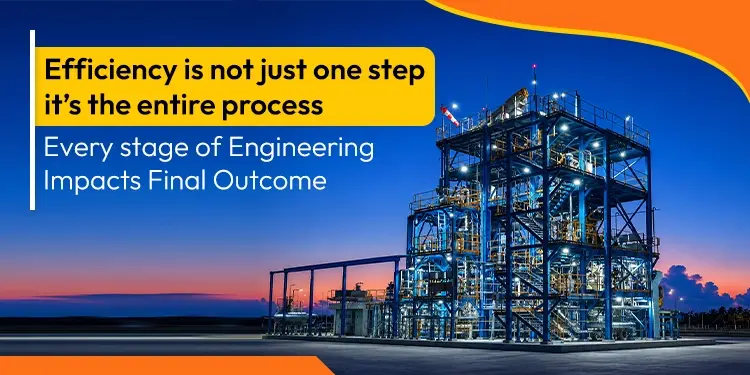
Efficiency is not just one step it’s the entire process – Every stage of Engineering Impacts Final Outcome
True operational performance is never a lucky accident or an isolated design milestone. Instead, it serves as the ultimate sum of minor and major technical choices made throughout the engineering lifecycle. For industries scaling up complex chemical or refining reactions, process development Pilot Plants represent the vital bridge between a lab-scale beaker experiment and safe commercial production. By evaluating technical feasibility early, committing to strict front-end engineering design (FEED), and leveraging skid-mounted modular systems, organizations can proactively control execution risks, preserve thermal stability, and capture high-fidelity process data to justify downstream investments.Engineering Operational Excellence: Why Every Decision Shapes Process Development Pilot Plants
Moving an innovative chemical process out of the laboratory and onto the commercial production floor is a path filled with technical hurdles. A formula that behaves predictably inside glass laboratory equipment can present serious thermodynamic, mechanical, or safety challenges when scaled up to thousands of liters. This critical transition area is where process development Pilot Plants become essential tools for process validation. True operational reliability in these facilities cannot be achieved simply by choosing premium hardware at the final stage. Instead, long-term efficiency remains the direct result of every structural and technical decision made across the entire project lifecycle. From confirming early concepts to final site testing, structured engineering paths ensure that commercial assets remain cost-effective and structurally sound.The Impact of Early-Stage Engineering Choices
Building a reliable facility requires an integrated process that begins long before field installation. The first phase centers on technical feasibility studies to convert early laboratory data into actionable designs, especially when baseline process information is limited. Evaluating technical feasibility allows teams to analyze raw material variables, assess necessary utility footprints, and map potential equipment constraints before allocating major funds. Once feasibility is confirmed, the project advances to front-end engineering design (FEED). This step transforms initial ideas into highly accurate technical documentation, including Process Flow Diagrams (PFDs) and Piping & Instrumentation Diagrams (P&IDs). Every instrument loop, valve location, and line size chosen during FEED directly impacts future maintenance intervals and long-term project control.- CAPEX and OPEX Modeling: Detailed early engineering provides a clear overview of capital expenses and expected operational costs, allowing leaders to make predictable investment choices.
- Operational Risk Mitigation: Conducting a thorough HAZOP assessment during early design identifies potential safety issues and functional risks, maintaining compliance with safety standards.
- Minimizing Gaps: A clear progression from conceptual phases to detailed engineering ensures that the built physical system matches the initial process intent perfectly.
Overcoming Scale-Up Challenges with Skid-Mounted Modular Systems
In industrial environments like oil and gas, pharmaceuticals, and alternative energy, process variables like thermal stability and pressure control must be closely managed. If a system experiences unexpected heat variations, the resulting validation data becomes unreliable, putting the commercial investment at risk. To protect data integrity, modern facilities rely heavily on skid-mounted modular systems. Constructing units as standalone, pre-tested modules yields significant advantages in project control:- Controlled Fabrication Environments: Building modules inside a specialized high-bay factory allows technical teams to execute assembly and Factory Acceptance Testing (FAT) in a clean, dust-free setting.
- Structural Portability and Flexibility: Modular systems can be completely tested, carefully split for transit, and rapidly reassembled at the destination, reducing structural construction delays.
- Advanced Instrumentation Integration: Incorporating customized SCADA programming and dependable PLC platforms ensures that process loops communicate cleanly with control hardware, reducing data noise.
Turning Process Data into Commercial Capital
It is crucial to remember that the primary deliverable of process development Pilot Plants is not just the physical liquid or chemical product created it is the engineering data generated. This data forms the foundational evidence required to construct full-scale commercial manufacturing lines. Achieving high-fidelity data acquisition precision requires absolute calibration across every sensor, heating jacket, and control loop. Highly engineered systems isolate internal process chemistry from outside environmental interference. This isolation allows research teams to stress-test process boundaries safely, establish repeatable production outcomes, and confirm commercial viability with total certainty. When every minor design choice aligns toward system precision, the entire scale-up journey shifts from an uncertain guessing game into a predictable, data-driven science. Partner with Xytel India for Your Next Scale-Up Project Overcoming the technical challenges of process development requires an experienced partner who understands that every engineering choice impacts long-term plant performance. For over three decades, Xytel India has delivered turnkey, fully automated, and skid-mounted modular process development Pilot Plants for leading global enterprises across the oil and gas, chemical, and pharmaceutical sectors. From early technical feasibility studies and precise front-end engineering design to final site commissioning, our expert engineering team ensures your innovations move smoothly from lab testing to commercial market success. Contact the engineering specialists at Xytel India today to discuss your process validation goals.Frequently Asked Questions (FAQs)
- Why are process development Pilot Plants necessary if laboratory testing was successful? Laboratory environments routinely isolate small fluid volumes, making it simple to maintain uniform pressures and temperatures. Scaling up introduces non-linear complexities like thermal instability, complex fluid dynamics, and unpredictable mixing behaviors that must be evaluated and resolved in a semi-commercial environment before investing in full-scale production.
- How do skid-mounted modular systems help reduce overall project delays? Modular fabrication allows field site preparation and plant equipment construction to occur at the same time. Because assembly and initial commissioning take place inside a controlled factory environment, field installation time is significantly shortened, and unexpected integration errors are minimized.
- What role does front-end engineering design (FEED) play in managing long-term operational costs? FEED establishes the definitive technical foundation for the facility by delivering highly accurate P&IDs, equipment datasheets, and HAZOP assessments. Making precise engineering choices during this early stage prevents expensive field re-works, optimizes utility requirements, and lowers long-term maintenance costs.
Get in Touch
You will be amazed as how partnering with us becomes a game changer in your quest for R&D glory.