Premier Pilot Plant People

 Call Us
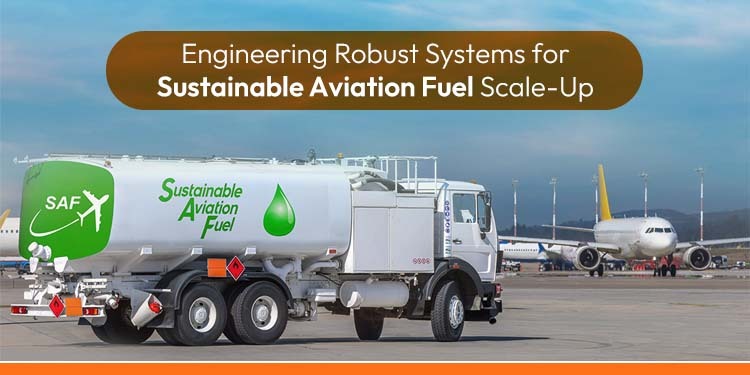
Engineering Robust Systems for Sustainable Aviation Fuel Scale-Up
This technical guide explores the critical engineering requirements for moving Sustainable Aviation Fuel (SAF) from experimental stages to commercial reality. It focuses on the necessity of system reliability, the mitigation of process efficiency challenges, and how strategic scale-up engineering ensures that new fuel technologies remain viable at industrial volumes. The global aviation industry is currently navigating one of its most significant transitions: the shift toward net-zero carbon emissions. Central to this transformation is Sustainable Aviation Fuel (SAF). While the chemistry behind various SAF pathways, such as Alcohol-to-Jet and Hydroprocessed Esters and Fatty Acids, is well understood in laboratory settings, the industry now faces a different kind of pressure. The primary challenge has shifted from can we make it? to can we make enough of it consistently? Addressing the increasing demand for bio-jet fuel requires more than just building larger versions of laboratory setups. It demands a sophisticated approach to Sustainable Aviation Fuel Scale-Up that prioritizes mechanical reliability and long-term operational value.Navigating the Increasing Demand for SAF
Global mandates and corporate sustainability goals are driving an unprecedented surge in the need for alternative fuels. However, as production volumes rise, the complexities of the manufacturing process often grow exponentially. This is where the importance of scale-up engineering becomes evident. Transitioning from a small-batch process to a continuous commercial stream involves managing intricate heat transfers, maintaining catalyst integrity, and ensuring feedstocks are processed with minimal waste. At Xytel India, the focus remains on bridging this gap. A successful Sustainable Aviation Fuel scale-up strategy ensures that the performance observed during the R&D phase is replicated, or even improved upon, when the plant reaches full capacity.Solving Process Efficiency Challenges
One of the most significant barriers to commercializing new fuel technologies is the efficiency loss that often occurs during expansion. What works in a controlled, five-liter reactor may behave unpredictably when scaled to a thousand-gallon system. Common process efficiency challenges include:- Mass and heat transfer limitations: Large-scale reactors often struggle with temperature gradients that can lead to sub-optimal chemical reactions or byproduct formation.
- Pressure management: Maintaining consistent flow rates across large-scale skids requires precise pump and valve integration.
- Catalyst degradation: In SAF production, catalysts are often the most expensive component. Protecting them from poisoning or physical breakdown is essential for maintaining a high yield.
The Need for Reliable Systems
In the industrial sector, reliability is the foundation of profitability. A SAF plant that suffers from frequent unscheduled downtime will never achieve the cost-per-gallon targets required to compete with traditional fossil fuels. This makes the design of SAF systems a matter of high-stakes engineering. Reliability begins with the hardware. Using modular, skid-mounted systems allows for better quality control during the fabrication process. It also ensures that the plant is easier to maintain. When components are accessible and the system architecture is logical, routine maintenance can be performed quickly, keeping the plant online and productive. Furthermore, a reliable system must be able to handle variations in feedstock. Whether the plant is processing used cooking oils, agricultural residues, or municipal waste, the engineering must be robust enough to maintain a consistent output of high-quality aviation fuel.Strategic Design for Consistent Performance
Consistency is the ultimate goal of any Sustainable Aviation Fuel scale-up project. Airlines require fuel that meets rigorous international standards every single time a tank is filled. To achieve this, the engineering team must focus on:- Automation and Control: Implementing advanced monitoring systems that can adjust process parameters in real-time.
- Materials Science: Selecting alloys and seals that can withstand the specific chemical environments of SAF production, which often involve high temperatures and corrosive intermediates.
- Modularization: Building systems in a way that allows for future expansion without disrupting existing operations.
Frequently Asked Questions:
1. What are the main challenges in a Sustainable Aviation Fuel scale-up?
The primary challenges include maintaining process efficiency at higher volumes, ensuring catalyst longevity, and managing the high capital costs associated with moving from laboratory testing to commercial-scale production.
2. Why is a pilot plant necessary for SAF production?
A pilot plant serves as a critical bridge. It allows engineers to test the technology in a real-world environment, providing the necessary data to prove that the process is commercially viable and reliable before full-scale investment occurs.
3. How does process efficiency impact the cost of SAF?
Efficiency directly relates to the yield of the fuel and the energy consumed during production. Higher efficiency means more fuel is produced from the same amount of feedstock with less waste, which is essential for bringing the price of SAF closer to that of conventional jet fuel.
Get in Touch
You will be amazed as how partnering with us becomes a game changer in your quest for R&D glory.