Premier Pilot Plant People
 Call Us
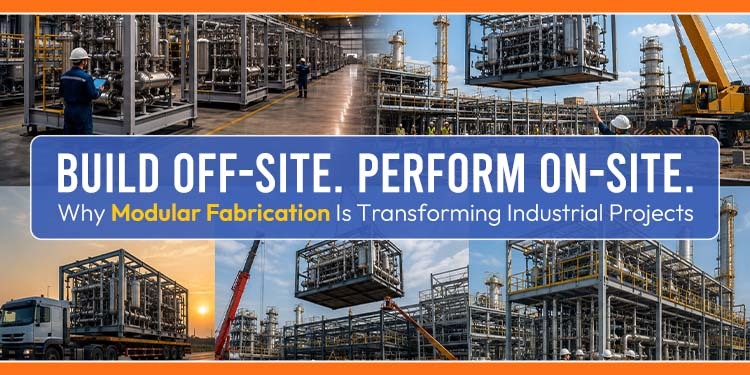
Why Modular Fabrication is Transforming Industrial Projects
Traditional field construction often subjects process plant development to schedule slips, site safety hazards, and unpredictable weather delays. Modern industrial facilities are shifting toward off-site engineering methods to maintain control over process development. Building specialized pilot plants and commercial skids inside precision shop environments allows plant owners to achieve strict quality standards, lower installation overheads, and shrink commissioning timelines. This technical guide explores how integrated off-site fabrication changes process economics and project safety.The Paradigm Shift in Industrial Project Delivery
For decades, the standard path for scaling process technologies involved field-erected assembly. Engineers shipped loose piping, instrumentation, structural frames, and reaction vessels directly to the project site, relying on large field crews to weld, fit, and wire everything together under open skies. Today, complex process industries, including specialty chemicals, petrochemicals, refining, energy transitions, and pharmaceuticals, are moving away from stick-built execution. Shifting core fabrication to a specialized shop environment changes the baseline for speed, cost-predictable metrics, and operational performance. By utilizing a fully integrated modular fabricated unit, EPC contractors and plant owners bypass site constraints. The core equipment, piping networks, control systems, and structural bases arrive at the plant site pre-assembled, factory-tested, and ready for swift integration into civil foundations.Technical Advantages of Off-Site Modular Construction
Understanding why industrial leaders choose off-site execution requires looking at the engineering trade-offs between field construction and controlled shop assembly.1. Controlled Assembly Environment
Field welding and wiring are subject to weather variations, space restrictions, and high-risk overhead work. In contrast, shop fabrication occurs inside a dedicated, climate-controlled facility equipped with overhead cranes, automated orbital welding systems, and specialized jigging setups.- Superior Quality Management: Critical welds on high-alloy piping (such as Hastelloy, Inconel, or 316L stainless steel) require precise purge gas coverage and stable ambient conditions to prevent contamination.
- Non-Destructive Testing (NDT): Radiographic inspection, dye penetrant checks, and hydro-testing happen progressively on the shop floor without interrupting civil works occurring simultaneously at the client site.
2. Parallel Path Execution Schedules
In traditional stick-built projects, activities occur sequentially. Site civil work must finish before structural steel can rise, and steel must be complete before piping and instruments go in. Modular execution breaks this linear constraint by enabling concurrent engineering:- Site Preparation: Foundations, utility hookups, and civil infrastructure advance at the target location.
- Module Fabrication: Fabrication, electrical tray routing, tube bending, and panel wiring for modular pilot plants proceed simultaneously at the manufacturing center.
| Process Unit Application | Stick-Built Challenges | Modular Solution Advantages |
| High-Pressure Catalytic Reactors | Complex field welding, tight piping tolerances, difficult field calibration. | Factory-calibrated mass flow controllers, certified pressure testing before shipment. |
| Distillation & Evaporation Units | Elevated scaffolding requirements, weather-dependent vertical assembly. | Pre-assembled multi-tier structural frames assembled horizontally and tested prior to shipping. |
| Gas Handling & Vacuum Packages | Sensitive instrumentation exposed to construction dust and field debris. | Cleanroom-level instrument installation and factory loop testing. |
| Lab-Scale and Pilot Scale Plants | Disruption to ongoing plant operations during installation. | Plug-and-play installation during planned shutdown windows. |
Risk Mitigation, Safety, and Quality Assurance
Safety and regulatory compliance represent two of the largest cost variables in modern capital projects. On-site labor hours carry inherent risks due to congested workspaces, hot work permits, and elevated scaffolding activity. Work completed off-site inside a dedicated manufacturing shop significantly reduces overall high-risk site hours:- Reduced Site Congestion: Minimizes the total workforce presence on active industrial sites, decreasing safety risk exposure.
- Factory Acceptance Testing (FAT): Before shipment, a modular fabricated unit undergoes comprehensive cold testing, loop checks, leak checks, and automation sequence verification. Identifying software bugs or mechanical mismatches on the factory floor costs a fraction of fixing them in the field during live commissioning.
- Transport Optimization: Modules are engineered specifically to fit standard freight constraints (ISO frame layouts, heavy-haul trailers) while preserving structural stiffness against transport vibration.
How Xytel India Drives Modular Excellence
Scaling up chemical processes demands deep domain expertise in process design, thermal management, and automation. At Xytel India, we specialize in translating complex process flow diagrams into robust modular pilot plants and demonstration facilities. Our engineering team oversees the complete lifecycle from initial process engineering and 3D CAD modeling to shop fabrication, Factory Acceptance Testing, and on-site integration. By focusing on skid-mounted delivery, we ensure process accuracy, repeatable scale-up data, and minimal downtime for your facility.Frequently Asked Questions
1. What is the difference between skid-mounted systems and stick-built construction?
A skid-mounted system is designed, fabricated, wired, and pre-tested on a structural frame off-site inside a specialized factory. Stick-built construction involves shipping loose individual components to the site and building the entire unit from scratch in the field.2. How do modular pilot plants handle shipping and structural limits?
During the initial 3D design phase, engineers model the overall dimensions and structural frame using Finite Element Analysis (FEA) to ensure structural integrity during lift-and-shift operations and road transit. Units are sized to conform to standard shipping constraints or designed as multi-skid blocks that bolt together seamlessly on site.3. Can existing process facilities integrate modular fabricated units easily?
Yes. Modular units are constructed with explicit battery-limit connections for power, utilities, feedlines, and product outputs. This clean interface simplifies hookup work, allowing new process skids to integrate into operational plants with minimal downtime.Get in Touch
You will be amazed as how partnering with us becomes a game changer in your quest for R&D glory.