Premier Pilot Plant People

 Call Us
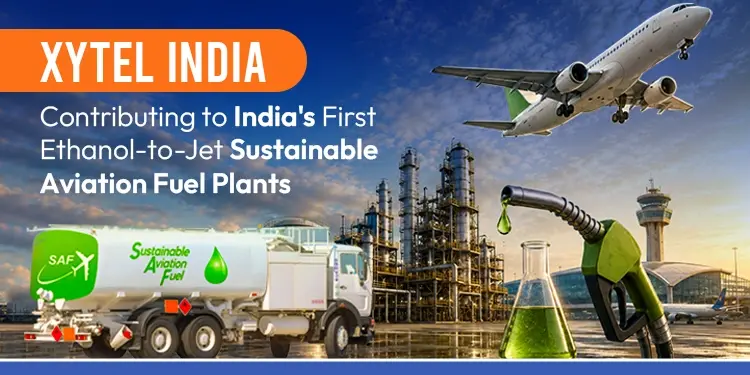
Xytel India- Contributing to India’s First Ethanol-to-Jet Sustainable Aviation Fuel Plants
The global aviation sector faces an immediate technical mandate to lower lifecycle greenhouse gas emissions, placing sustainable aviation fuel at the center of modern aerospace strategy. As the industry bridges the gap between laboratory chemistry and commercial viability, process engineering serves as the foundational link. This technical blog analyzes the complex requirements of scaling alcohol-to-jet pathways, highlighting Xytel India’s recent selection to provide detailed engineering for the core process package of India’s pioneering Ethanol-to-Jet sustainable aviation fuel Pilot Plants at NTPC’s Green Hydrogen Hub in Andhra Pradesh. By evaluating modular design methodologies, precise multi-stage chemical control, and data-driven thermal management, we illustrate how structured early-stage engineering eliminates industrial operational risks.Introduction to the SAF Evolution
The international aviation industry is undergoing a structural transition toward deep decarbonization, driven by the global mandate to achieve net-zero carbon emissions by 2050. Because long-haul commercial flights cannot easily utilize battery or pure hydrogen propulsion in the near term, sustainable aviation fuel has emerged as the most viable alternative to conventional hydrocarbon jet fuels. Derived from renewable feedstocks, agricultural residues, and industrial alcohols, sustainable aviation fuel can lower lifecycle carbon emissions significantly. However, a major industrial challenge remains: while laboratory-scale chemical pathways are proven, transforming these bench-scale innovations into thousands of metric tons of annual production requires a complete shift in how process engineering and system infrastructure are planned.The Scaling Challenge: Navigating the Process Scale-Up Journey
Transitioning a complex chemical process from a controlled laboratory setting to an industrial environment is rarely straightforward. In a bench-scale environment, managing a precise chemical reaction inside a small glass flask is relatively simple because thermal gradients are minimal and fluid dynamics are easily controlled. When moving toward larger production scales, the physical behavior of chemical mixtures shifts dramatically:- Thermal Instability and Heat Flux: At larger process volumes, the surface-to-volume ratio drops sharply. This variation makes it difficult to dissipate or introduce heat evenly, leading to severe thermal gradients that can degrade product purity or trigger runaway reactions.
- Precise Process Control: The alcohol-to-jet pathway requires precise, multi-stage chemical reactions. Maintaining high product yield and strict aviation-grade purity requires millisecond-level automated control over pressure, flow velocity, and transient process states.
- Feedstock Variability: Processing renewable ethanol requires systems designed to handle inconsistent raw material characteristics without causing process disruptions or localized pressure drops.
Mitigating Risks with Modular and Skid-Mounted Design
Modern process development favors flexibility and predictable deployment schedules. For alternative energy projects, traditional field construction often faces structural delays, environmental challenges, and high field integration costs. To overcome these hurdles, Xytel India employs a structured, modular engineering methodology. Process systems are designed, fabricated, and fully instrumented as compact, skid-mounted assemblies within a controlled factory setting before being shipped directly to the project site. This modular configuration delivers distinct operational benefits:- Parallel Project Execution: Equipment fabrication occurs simultaneously with structural site preparation in Andhra Pradesh, reducing overall project timelines.
- Advanced Automation and Data Quality: Integrating built-in SCADA programming and customized programmable logic controller frameworks ensures high-fidelity data acquisition and excellent process repeatability.
- Operational Accessibility: Designing clean, structured equipment layouts ensures that primary reactors, separation columns, and analytical instruments remain easily accessible for routine maintenance, supporting long-term plant availability.
The Long-Term Economic and Environmental Impact
The transition toward cleaner air travel is an economic challenge as much as a technical one. Currently, sustainable aviation fuel carries a production cost premium compared to fossil-based jet fuel. Addressing this cost gap requires optimizing plant energy efficiency and reducing operational expenditure through smart process design. By incorporating tight thermal integration loops and minimizing system pressure drops right from the initial design phase, advanced process engineering ensures that alternative energy infrastructure can operate reliably under demanding industrial conditions. This landmark plant at NTPC’s Green Hydrogen Hub establishes a clear blueprint for future alternative energy projects across India. It proves that with the right combination of chemical innovation, detailed engineering, and rigorous pilot-scale validation, the transition to sustainable industrial processes can be achieved with high technical and financial confidence. Ready to Scale Your Next Process Innovation? Moving a complex chemical process from the laboratory bench to reliable commercial scale requires deep technical experience and precision engineering. At Xytel India, we specialize in bridging this gap by delivering turnkey, automated, and skid-mounted Pilot Plants solutions designed for the alternative energy, petrochemical, and specialty chemical sectors. Contact our engineering team today to discuss your process validation goals and learn how our structured design workflows can help bring your technology to market efficiently.Frequently Asked Questions
1. What is the role of pilot plants in sustainable aviation fuel production?
A Pilot Plants serves as an intermediate testing phase between small laboratory experiments and large commercial manufacturing facilities. It replicates industrial operating conditions on a scalable level, allowing process engineers to gather high-fidelity data, isolate unexpected chemical behaviors, analyze thermal changes, and optimize equipment performance before full-scale capital deployment.2. Why is the Ethanol-to-Jet chemical pathway complex to scale up?
The alcohol-to-jet pathway involves multi-stage chemical reactions that demand precise, continuous process control to maintain product purity. As production volume scales up, managing heat transfer becomes difficult due to decreasing surface-to-volume ratios, making early-stage detailed engineering and automated thermal management critical.3. What advantages does modular engineering offer for alternative energy plants?
Modular and skid-mounted engineering allows process packages to be built, assembled, and tested within a controlled factory facility in parallel with on-site civil preparation. This design methodology shortens deployment schedules, lowers integration costs, simplifies system maintenance, and allows capacity to be expanded incrementally.Get in Touch
You will be amazed as how partnering with us becomes a game changer in your quest for R&D glory.