Premier Pilot Plant People

 Call Us

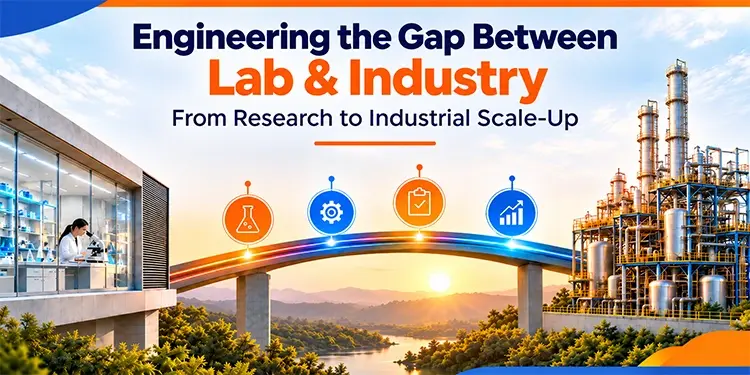
Engineering the Gap Between Lab & Industry: From Research to Industrial Scale-Up
Moving an innovative process from laboratory research to industrial production requires more than successful experiments. It demands process engineering, technical validation, pilot plant development, equipment design, and operational planning. This blog explores how engineering connects laboratory findings with industrial requirements, why pilot plants are essential for process scale-up, and how Xytel India supports the transition from research to commercial implementation.Introduction: Where Innovation Meets Engineering
Innovation begins in the laboratory, where researchers investigate chemical reactions, develop new materials, and evaluate process feasibility. However, achieving successful laboratory results does not automatically mean that the same process will perform efficiently at industrial scale. The real challenge lies in translating laboratory data into practical engineering solutions. This requires Front-End Engineering Design (FEED) services, process evaluation, equipment selection, and a clear understanding of how operating conditions change as production capacity increases. Bridging this gap is essential for industries looking to commercialize new technologies while maintaining process reliability, product quality, operational safety, and economic viability. At Xytel India, we believe engineering is the bridge between innovation and implementation.1. Why Laboratory Success Does Not Guarantee Industrial Performance
Laboratory experiments generally operate under controlled conditions. Researchers work with smaller quantities, simplified equipment configurations, and closely monitored operating parameters. Industrial operations introduce several additional challenges:- Heat transfer limitations: Larger equipment changes the surface-area-to-volume ratio, affecting temperature control and reaction efficiency.
- Mass transfer variations: Gas-liquid-solid interactions can behave differently when process volumes increase.
- Mixing and fluid dynamics: Maintaining uniform mixing and consistent flow becomes more complex in larger vessels.
- Material handling: Pumping, conveying, feeding, and processing larger material quantities introduce practical operating challenges.
- Process safety: Pressure management, temperature excursions, relief systems, and emergency shutdown requirements need detailed evaluation.
2. Pilot Plants: The Critical Link Between Laboratory and Industry
A pilot plant provides an intermediate operating environment between laboratory experiments and commercial production. It allows engineers to evaluate how a process behaves under conditions that more closely resemble industrial operations. Unlike laboratory equipment, pilot plants can incorporate actual process equipment, instrumentation, piping arrangements, utilities, and automated control systems. A structured process development journey generally involves three stages: Laboratory Scale- Establishing chemical feasibility.
- Studying reaction behaviour and process conditions.
- Identifying preliminary operating parameters.
- Testing process performance under representative operating conditions.
- Evaluating heat and mass transfer.
- Studying equipment performance and process stability.
- Collecting operating data for engineering calculations.
- Evaluating pre-commercial production.
- Assessing operational reliability and production consistency.
- Generating data for full-scale plant design and commercial implementation.
3. Engineering Calculations That Support Successful Scale-Up
Reliable industrial process scale-up depends on converting experimental observations into measurable engineering parameters. Some of the important technical considerations include: Mass and Energy Balances: These calculations establish material input, output, losses, and energy requirements. They help engineers understand process efficiency and identify opportunities for optimization. Equipment Sizing: Reactors, heat exchangers, pumps, vessels, and other equipment must be sized according to process requirements, operating pressure, temperature, flow rates, and material properties. Hydraulic Calculations: Pressure drop, fluid velocity, and piping dimensions influence the selection of pumps, pipelines, and associated process equipment. Heat Transfer Evaluation: Heat exchanger performance and thermal management become particularly important when moving from laboratory reactions to larger processing systems. Relief Valve Sizing: Engineers evaluate potential overpressure scenarios to establish suitable pressure relief requirements and protect equipment. Process simulation tools such as CHEMCAD and in-house simulation programs can support mass and energy balances, unit operation evaluation, piping hydraulics, relief system design, and heat exchanger assessment. These calculations provide the technical foundation for developing reliable pilot, demonstration, and commercial plants.4. From Process Design to Industrial Implementation
Engineering does not stop after the process parameters are established. The next stage involves translating calculations into practical plant design and execution documents. Xytel India’s Basic and Detailed Engineering services support this transition through activities such as:- Equipment sizing and hydraulic calculations.
- Preparation of Process and Instrumentation Diagrams (P&IDs).
- Equipment specifications and equipment lists.
- Utility consumption summaries.
- Relief scenario specifications.
- Tie-in point lists and cause-and-effect diagrams.
- Plant layout and graphics development.
- Participation in Hazard and Operability (HAZOP) studies.
5. Automation and Process Control: Making Industrial Operations Reliable
Industrial implementation requires consistent monitoring and control of operating conditions. Instrumentation and automation systems help engineers monitor critical parameters such as pressure, temperature, flow, and level. Programmable Logic Controllers (PLCs), Distributed Control Systems (DCS), and Supervisory Control and Data Acquisition (SCADA) systems support process monitoring, data collection, and automated control. Xytel India provides automation and control system design and integration for industries including oil and gas, pharmaceuticals, polymers, petrochemicals, and fine chemicals. The company also has an in-house SCADA programming capability and a dedicated data acquisition centre. These capabilities help connect process equipment with instrumentation and control systems, supporting better operational visibility and process evaluation.6. Building the Engineering Foundation for Commercial Success
The transition from laboratory research to industrial implementation requires collaboration between researchers, process engineers, equipment designers, and plant operators. Xytel India’s infrastructure supports this engineering workflow. Its facilities include:- 3,000 sq. ft. high-bay facility: Designed for constructing large-scale plants up to 45 feet in height.
- 5,000 sq. ft. low-bay facility: Equipped with a 20-foot ceiling for plant assembly and Factory Acceptance Testing (FAT).
- Design office: Equipped with engineering design software for project planning and execution.
- Data acquisition centre: Supporting in-house software development and SCADA programming for PLC platforms.
Conclusion: Engineering Turns Research into Industrial Reality
The journey from laboratory research to industrial production involves several interconnected engineering decisions. Process feasibility, pilot-scale validation, equipment sizing, safety evaluation, automation, and detailed engineering all contribute to successful commercialization. A well-planned pilot plant provides the operating data needed to make informed decisions before committing to commercial infrastructure. At Xytel India, engineering connects research with practical industrial requirements. By combining process engineering, pilot plant development, automation, and detailed design capabilities, the company helps organizations move promising technologies towards industrial implementation. Innovation may begin in the laboratory, but sound engineering determines how successfully it reaches industry.Frequently Asked Questions (FAQs)
1. What is the biggest challenge in moving a process from laboratory to industrial scale?
The biggest challenge is maintaining process performance when operating conditions change. Heat transfer, mass transfer, mixing, equipment capacity, material handling, and safety requirements must all be evaluated during scale-up.2. Why are pilot plants important in industrial process development?
Pilot plants help validate laboratory findings under representative operating conditions. They generate practical data about process performance, equipment behaviour, operating parameters, and production requirements before commercial investment.3. What is the difference between a pilot plant and a demonstration plant?
A pilot plant is primarily used for process development, testing, and validation. A demonstration plant operates at a pre-commercial level and helps evaluate production performance and the feasibility of larger-scale implementation.4. What engineering calculations are required for process scale-up?
Important calculations include mass and energy balances, equipment sizing, hydraulic calculations, heat exchanger evaluation, pressure relief sizing, and utility consumption estimates. These calculations support equipment selection and plant design.5. How does Xytel India support the transition from laboratory research to industrial production?
Xytel India supports this transition through turnkey pilot and mini plants, FEED, basic and detailed engineering, process simulation, equipment design, automation, control system integration, and commissioning support.Get in Touch
You will be amazed as how partnering with us becomes a game changer in your quest for R&D glory.