Premier Pilot Plant People

 Call Us
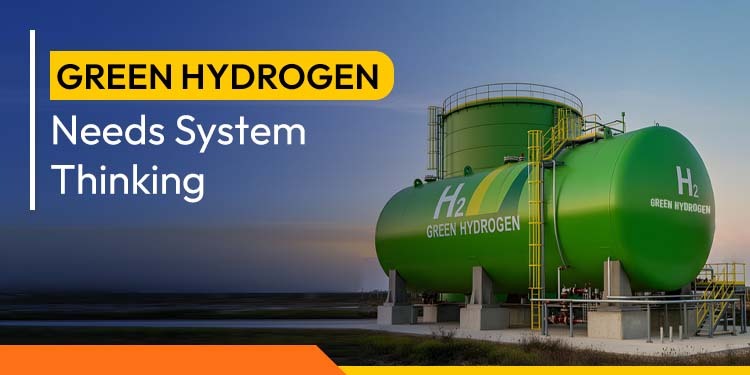
Green Hydrogen needs System Thinking
While the global spotlight remains fixed on electrolyser efficiency, the actual viability of green hydrogen depends on a much broader perspective. This blog explores why systems thinking, the practice of viewing production, storage, and distribution as a single, interdependent machine, is the essential factor in moving from successful Pilot Plants to commercial-scale reality. We analyse how managing technical dependencies and prioritising long-term reliability over theoretical peak performance determines the ultimate cost of hydrogen. In the race to reach net-zero, many project developers fall into the trap of component-centric thinking. They search for the most efficient electrolyser on the market, assuming that the rest of the infrastructure will fall into place. However, at Xytel, our experience in building complex process plants has shown that an electrolyser in isolation is just a piece of hardware. The real challenge lies in the integration. When we talk about system thinking in green hydrogen, we are looking at the plant’s holistic architecture. If the power supply fluctuates, how does the water purification system respond? If the storage pressure drops, how does that affect the downstream distribution? Success is not defined by how well one part works, but by how well the entire system communicates.1. Navigating Multiple System Dependencies
A green hydrogen Pilot Plant is a delicate balancing act among three primary inputs: renewable power, high-purity water, and physical storage space. These are not independent variables. For instance, the intermittent nature of solar or wind power requires a system that can handle rapid ramping up and down. This stress doesn’t just affect the electrolyzer; it impacts the pumps, the cooling systems, and the power electronics. A system-thinking approach ensures that the power conditioning units are perfectly matched to the stack’s requirements, preventing premature degradation. Water management is equally critical. If the deionization process fails to keep pace with production peaks, the entire plant grinds to a halt. We must design with these dependencies in mind to ensure the plant functions as a unified organism.2. Design-Led Performance vs. Peak Output
It is common to see manufacturers advertise record-breaking efficiency numbers. While impressive, these figures often represent peak performance under ideal lab conditions. In an industrial setting, reliability is far more valuable than a 1% gain in theoretical efficiency. Designing for performance means engineering for the ugly realities of operation. This includes thermal management, ease of maintenance, and the ability to operate under off-design conditions. A system that is easy to service and stays online for 98% of the year will always outperform a high-efficiency system that suffers from frequent downtime due to an over-complicated design. At Xytel, we focus on creating robust architectures where every valve, sensor, and controller is chosen to support long-term operational stability.3. How Efficiency Directly Impacts Lifecycle Cost
The cost of green hydrogen is often discussed in terms of capital expenditure (CAPEX). While the initial price of equipment matters, the lifecycle cost or the Levelized Cost of Hydrogen (LCOH) is where projects succeed or fail. Every point of energy loss across the system, from AC-DC conversion to compression for storage, adds to the final price per kilogram of H2. Systems thinking allows engineers to identify these hidden losses. By optimizing the Balance of Plant (BoP), we can minimize energy waste. For example, capturing waste heat from the electrolysis process to assist in other plant functions can significantly improve the overall energy balance. When you reduce the losses across the entire lifecycle, the economic case for green hydrogen becomes much stronger.4. The Critical Bridge: Scaling from Pilot to Commercial
The jump from a laboratory bench to a multi-megawatt facility is not a simple matter of making everything bigger. Scaling up introduces new complexities in fluid dynamics, heat dissipation, and safety protocols. Pilot Plants serve as the proof of concept for systems thinking. They allow us to test how integrated components behave under real-world stress. Insights gained at the Pilot stage, such as how the system handles grid instability or impurities in the water supply, are vital for de-risking large-scale investments. A well-integrated Pilot plant provides the data necessary to convince stakeholders that the technology is ready for commercial reality. It bridges the gap between a promising idea and a bankable industrial asset.Why Integration Defines Success
At Xytel India, we maintain that production is only one part of the story. The future of the hydrogen economy does not depend on a single breakthrough discovery but on the disciplined application of integrated engineering. When we apply system thinking, we move away from isolated components and toward a vision of cohesive, reliable energy infrastructure. We must consider the interplay between every gear and circuit. By focusing on design nuances and managing complex dependencies, we can build a green hydrogen sector that is not only environmentally sustainable but also economically formidable. Whether you are starting a new Pilot project or looking to optimize an existing facility, remember that the most efficient component in the world cannot compensate for a poorly integrated system. Integration is not just a phase of construction; it is the fundamental philosophy that ensures green hydrogen can meet the demands of a changing world.Get in Touch
You will be amazed as how partnering with us becomes a game changer in your quest for R&D glory.